

Walk down a barn aisle and you start to craft a story filled with seemingly benign judgments. That one is misbehaving. He is kicking the door. That one is trouble. She is pawing in the crossties. That one is fine… he is standing still.
I told myself those stories a thousand times, casually and automatically, because it is the story almost all of us were taught. Trouble is what you can see. So, when you cannot see any, there is none.
Underneath that is a single assumption. We assume a troubled animal will show us, that distress announces itself, that if something were really wrong we would see it. And nowhere do we trust that assumption more than with fear. Fear spooks, it braces, it bolts. So when the spooking stops, we believe the fear stopped with it.
Here is the thing. The absence of visible fear does not tell you that a frightened animal is at peace. It may tell you only that the fear is no longer being expressed in the way you expect.
Take a frightened horse and make him stop reacting. He may become watchful. He may stand still while every part of him remains organized around what might happen next. He is not grazing. He is not dozing with a hind leg cocked and his lower lip loose. He is not nosing the strange bucket somebody left in the corner just to find out what it is.
He looks, if anything, tense. Nobody walks past that horse and calls him fine.
But there is another possibility, and this one can fool many people, including me. Instead of staying up, the nervous system can shut down. It can quit.
There is a kind of horse who stands very still for long stretches. Neck flat and level with his back. Eyes open, staring, not much blinking. Ears fixed and pointed back. He does not react much to a person appearing at his stall, or to a sudden noise, or to being touched. He looks, honestly, like a horse who has finally settled.
He has not settled. He has given up.
Researchers have studied horses who display this kind of withdrawn behavior, and they found something that should stop all of us cold. Those withdrawn horses had lower plasma cortisol levels than their non-withdrawn neighbors. Lower. So if you had walked up and administered a lab test, the number might have looked reassuring even though there was something seriously wrong.
The number does not tell you the whole story. Neither does the behavior by itself. Neither tells you what kind of life is happening inside the animal.
On the surface those two horses could not look less alike. One is tight. The other is still. Yet neither is grazing quietly. Neither plays. Neither goes looking for anybody. The same things are missing from both.
That is why quiet tells you so little. Quiet is not the same as safe. Quiet is just quiet.
I have watched this play out with clients more times than I can count. Someone finds a horse who is dead quiet. Bombproof. Stands like a rock at the mounting block, does not care about the tarp or the traffic or the dog. They try him, they love him, they buy him. And three or four weeks after he gets home, he starts to act up. Suddenly he has opinions. And the question the new owner always asks, and it is a fair question, is whether he was drugged the day they rode him. Sometimes he was. That happens, and I am not naive about it.
But I have come to wonder about a different explanation. What if he was not drugged and not calm either? What if he was shut down? And then he went home with a kind person who turned him out with friends, and fed him well, and did not ask much of him for a few weeks… and he woke up.
That is not a horse getting worse. That is a horse coming back to life.
It just came back in a way the new owner did not order. Because what returns first, when a shut-down animal starts to revive, is not the pleasant stuff. It is the opinions. The reactions. The ability to say no. A creature waking up is not necessarily a tidy process. Yet I would rather have a horse with opinions and a plan for helping him than a horse who has quit.
I want to be careful here, because a horse who suddenly has opinions can be genuinely dangerous, and this is the moment to get good help. But it changes what you think you are looking at. The behavior did not come out of nowhere. It came out of him.
So it helps to better understand the flavors of quiet. A horse can stop reacting because reacting never helped, or because he is still watching, or because he has stopped expecting anything to change. None of that is safety.
Safety is not what remains when fear disappears. It is not an empty space where the trouble used to be. Safety has something in it. A horse who feels safe has room for the rest of his life.
He grazes. He rests. He investigates. He plays. He notices another horse and goes over to say hello. He wanders away again. He has opinions. He can startle and recover. He can say no and then come back. His nervous system is not simply quiet. It is available.
We do the same thing with each other, of course. Somebody says they’re fine and we believe them, because nothing is visibly on fire. No crisis, no tears, no call at midnight. But not falling apart is a very low bar to clear, and I have known plenty of people, and have been one myself, who cleared it for years while nothing good was actually happening inside their lives.
The absence of a problem is not the presence of an engaged life.
These days I ask different questions with both horses and people. I used to wonder what was wrong. The true answers to that question are often easy to disguise. Now I ask what is alive.
Is he eating like he means it? Is he curious about something? Does he play? Does he seek anybody out, or does he only tolerate being sought? With people, same question in different clothes. Not, are you managing. But, what lights you up and is there anything you are looking forward to?
It is a harder question. It does not let anybody off the hook, including me. But it is the honest one, because it looks for something rather than settling for the absence of something.
Peace is not what is left when the trouble stops.
Peace is comes from connection and is something a body goes out and does.
Look for that.
A horse’s lesson in healthy boundaries, relational safety, and staying yourself in close relationships.
Sit on a horse and you learn something about balance you can never quite unlearn. Balance is not a thing you get… and then keep. It is not a position you find once and settle into. It is a thousand tiny corrections, most of them too small to see, made and unmade and made again, breath by breath, stride by stride. The moment you stop correcting, you start to fall. Good riders do not look busy. They look still. But that stillness is not the absence of effort. It is effort so constant and so refined that it disappears.
I have come to believe that boundaries work the same way.
We talk about boundaries as if they were walls. Build them once, build them high, and you are safe. Keep people out and nothing can hurt you. I understand the appeal. But it has never matched what I actually see, in my clients, in my horses, or in myself.
A wall keeps everything out. That is all it knows how to do. And a person who has built one has not solved the problem of closeness or safety with others in this world. They have only stopped facing it.
A boundary is a different thing altogether. A boundary is not where I keep you out. It is where I end and you begin. It is my sense of myself, held steady, while you are near. And like balance, it is not a position. It is a living act, corrected moment by moment, and hardest to hold with the ones standing closest.
Here is something I have noticed about myself, and maybe you will recognize it. I can keep a clean, easy boundary with a horse that is not mine. All day long. I can be kind and clear and unbothered, ask what needs asking, and never once lose track of where I stop and the horse starts. Put me on my own horse, with my own hopes riding along, and it gets harder. The closer a thing is to my heart, the harder it is to stay myself inside it. My marriage of thirty-eight years is where I have practiced this the most, and still get it wrong the most. My grown sons, the same. The people I love most are the people I am most tempted to disappear into, or to wall off from. Same fear, two costumes.
Because that is the thing about losing your balance. It goes two ways.
Lean too far away and you harden. You become the fortress. Defended, unreachable, safe and alone. That danger is easy to see. We all know the person who has walled themselves off.
Lean too far toward the other and you disappear. You become the doormat, yes, but there is a deeper and truer name for what is happening. It is fusion. You melt into the other person, you become whatever the moment seems to need, until there is no you left in the room. And fusion is the danger we almost never name, because it does not look like a danger at all. It looks like devotion. It looks like love.
But it is every bit as dangerous as the wall, and in some ways worse, precisely because it hides so well. When I dissolve into you, there is no longer a me here to meet you. And two nervous systems with no boundary between them do not calm each other. They catch each other. Your worry becomes mine, mine feeds yours, and around we go, with no steady ground under either of us. I cannot help you find your feet if I have given away my own. The calm you borrow from me only works if I am still standing somewhere you are not. Fusion gives that away. It trades the two of us for one blurred thing that cannot hold anyone.
So both roads fail, and they fail in the same place. The fortress keeps everyone at arm’s length and calls it strength. The fused pour themselves out and call it love. Neither one has done the harder thing, which is to stay a whole, distinct person while letting another all the way in. That is why the person with no boundaries cannot actually afford the closeness they are chasing. Push them away, or vanish into them. Either way, no one is truly met. No one feels safe.
A boundary is what refuses that trade. If I know where I end, I can let you all the way in without fear of losing myself, because I know I will still be here when you go. It is the person with a clear, kind boundary who can afford to be generous. To be soft. To be truly open. I used to assume the most boundaried people would be the coldest. I have found the reverse. The warmest, most compassionate people I know are almost always the most clearly bounded. The fence is what lets them keep the gate open.
A boundary is a balance. It is the quiet, endless, mostly invisible work of staying yourself while staying close. You will lose it and find it, lose it and find it, especially with the ones you love, for as long as you live. That is not failure. That is what balance is.
The goal was never to need less of anyone, nor become one with someone else. The goal is to become someone who is solid and secure enough to be in close relationship with others, both horse and human and in this way build true safety.
~ Paul
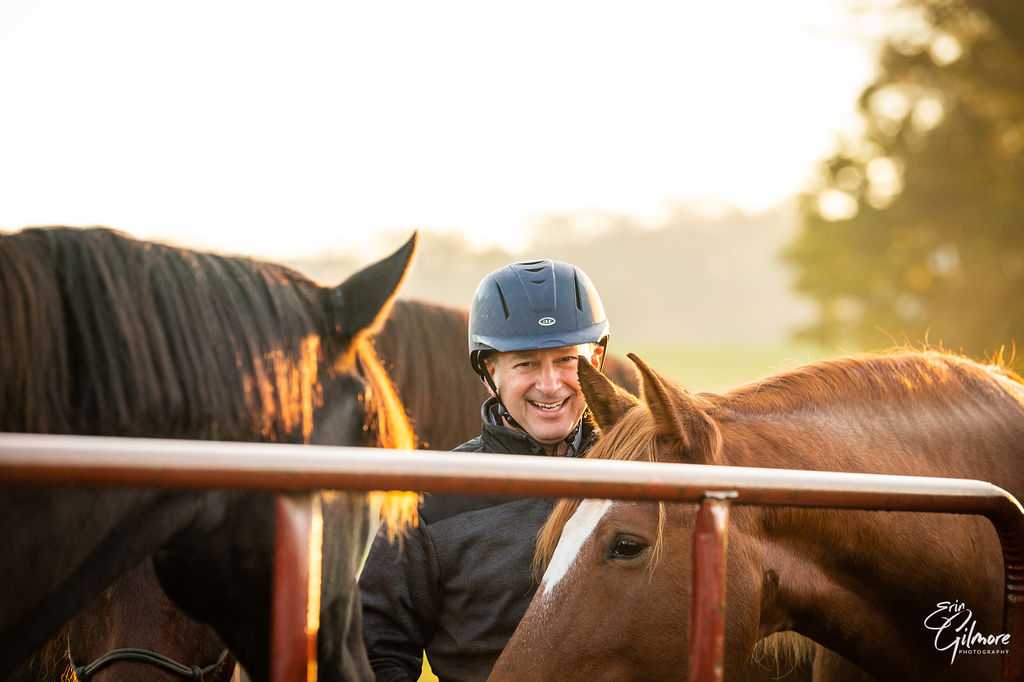
PC – Erin Gilmore Photography


LEAVE A COMMENT
Comments